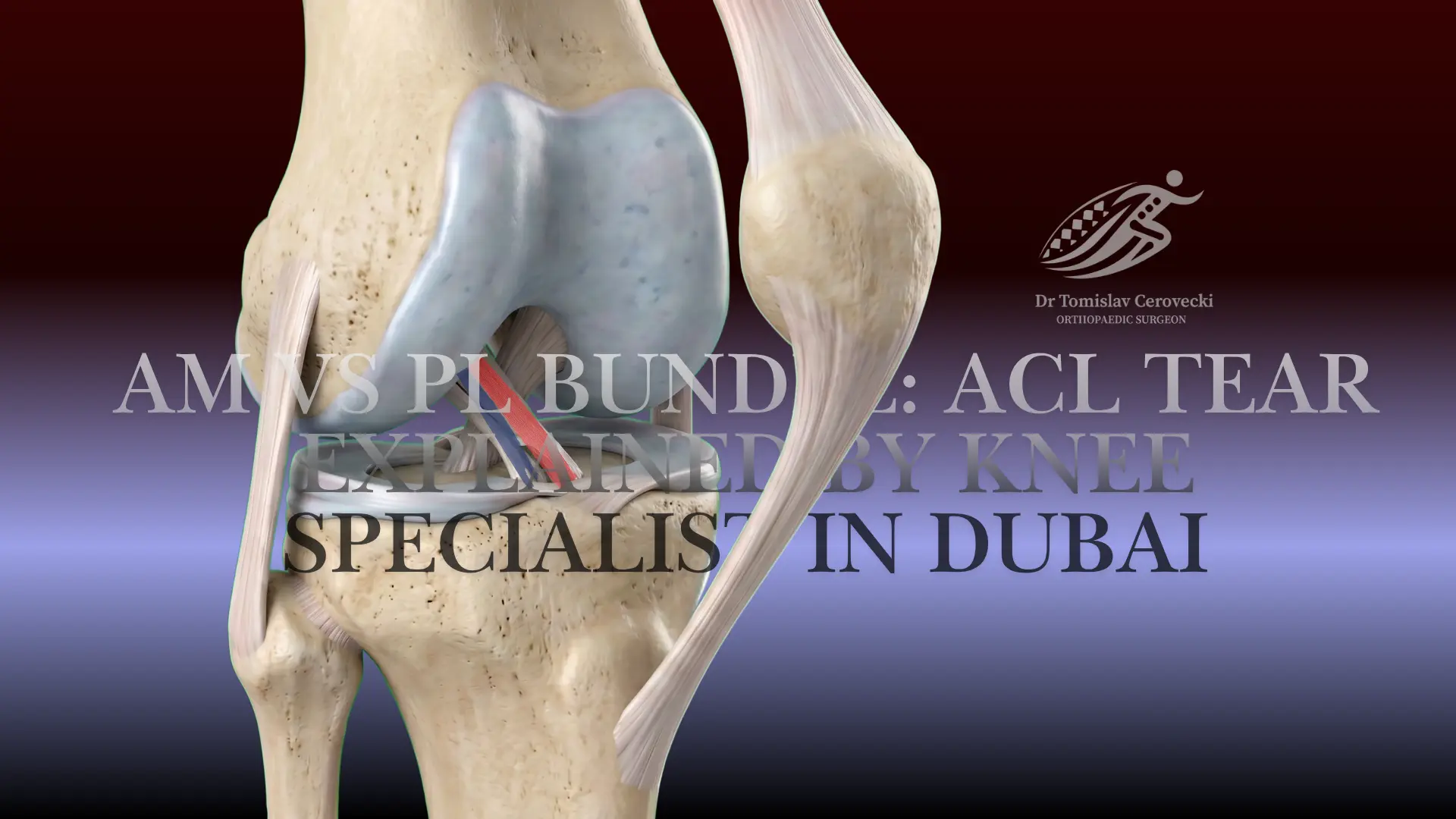


AM vs PL Bundle Concept: Why the ACL Is More Than One Simple Ligament
When most patients hear the term ACL tear, they imagine one ligament snapping like a single rope inside the knee. But the ACL is more complex than that. The ACL, or anterior cruciate ligament, is a key stabilizing structure inside the knee, and it works through different functional fiber groups that help control the knee in different positions and movements.
For patients, athletes, and active adults, understanding this concept is important because not every ACL injury feels the same, looks the same, or needs the same treatment. Some people with an ACL injury feel severe instability immediately. Others may have pain and swelling but still walk normally. This difference is one reason why a proper diagnosis should not depend only on one MRI sentence.
In this article, Dr. Tomislav Cerovecki, orthopedic surgeon in Dubai with a focus on knee injuries and sports medicine, explains the AM and PL bundle concept in simple patient-friendly language and why it matters for ACL injury diagnosis, treatment planning, and return to sport.
What Is the ACL?
The ACL, or anterior cruciate ligament, is one of the main ligaments inside the knee joint. It connects the femur, which is the thigh bone, to the tibia, which is the shin bone. Its main job is to help stabilize the knee during movement.
The ACL helps prevent the shin bone from sliding too far forward in relation to the thigh bone. It also plays an important role in controlling rotation of the knee. This rotational control is especially important in sports that involve sudden direction changes, pivoting, jumping, landing, or twisting.
This is why ACL injuries are commonly seen in sports such as:
- Football
- Basketball
- Tennis
- Padel
- Skiing
- Rugby
- Volleyball
- Martial arts
- High-intensity training
The ACL is not only important for professional athletes. It is also important for anyone who wants to walk confidently, climb stairs, exercise, run, or return to an active lifestyle after a knee injury.
The ACL Is Not Just One Simple Rope
A useful way to understand the ACL is to imagine it as a strong group of fibers, not one single rope. These fibers work together to control the knee in different positions.
Anatomically and functionally, the ACL is commonly described as having two main bundles:
1. AM Bundle, Anteromedial Bundle
AM stands for anteromedial.
The AM bundle is more active and more important when the knee is bent. This means that when the knee is in a flexed position, the AM bundle contributes significantly to controlling forward movement of the tibia and maintaining stability.
For example, when a person squats, lands, changes direction, or bends the knee during sport, the AM bundle plays an important role in knee control.
2. PL Bundle, Posterolateral Bundle
PL stands for posterolateral.
The PL bundle becomes more important when the knee is closer to straight. It contributes strongly to stability when the knee is near extension and also helps with rotational control.
This is important because many sports injuries happen when the knee is closer to straight, especially during sudden deceleration, pivoting, or landing from a jump.
Why These Two Bundles Matter Together
The AM and PL bundles do not work separately in real life. They work together as part of one functional ACL system.
Together, they help control:
- Forward sliding of the shin bone
- Rotation of the knee
- Stability during pivoting
- Stability during landing
- Confidence during cutting movements
- Protection during sport-specific movements
This is why the ACL is so important in sports and why an ACL injury can make the knee feel unsafe even if walking in a straight line still feels possible.
Quick Answer: What Is the Difference Between the AM and PL Bundle of the ACL?
The AM bundle of the ACL is more important when the knee is bent, while the PL bundle is more important when the knee is closer to straight. Together, these two bundles help control forward movement and rotation of the knee. This is why ACL injuries can cause instability, giving way, swelling, and difficulty returning to sports that involve pivoting, cutting, or landing.
Why One ACL Tear Can Feel Different From Another
One of the most important points for patients is this: an ACL injury is not always the same in every person.
Some patients have a complete ACL tear, where the ligament is fully torn and the knee becomes clearly unstable. These patients may describe the knee as giving way, shifting, or feeling unreliable during turning or pivoting.
Other patients may have a partial ACL tear, where one part of the ACL is injured more than the other. For example, the AM bundle may be damaged while some PL fibers are still working. In another case, PL fibers may be more affected while part of the AM bundle remains functional.
This can explain why two patients may both have the words “ACL tear” written on their MRI report, but their symptoms are not identical.
Patient Example 1: Instability During Turning
One patient may say:
“My knee gives way every time I turn.”
This type of complaint suggests functional instability. The patient may feel okay when walking slowly but unsafe when trying to pivot, run, or return to sport.
Patient Example 2: Pain and Swelling but Normal Walking
Another patient may say:
“I have pain and swelling, but I can still walk normally.”
This patient may still have an ACL injury, but their functional instability may be less obvious during daily activity. Walking straight does not challenge the ACL in the same way that cutting, jumping, landing, and pivoting do.
This is why the patient’s story, symptoms, sport level, and clinical examination are essential.
Why MRI Alone Is Not Enough for ACL Treatment Decisions
MRI is very useful in diagnosing ACL injuries. It helps show the ligament, meniscus, cartilage, bone bruising, and other associated injuries. However, MRI should not be the only factor used to decide treatment.
The American Academy of Orthopaedic Surgeons explains that assessment of ACL injuries includes the patient’s history and physical examination, and that many ligament injuries can be diagnosed through a thorough knee examination.
This matters because an MRI is an image. It does not fully show how the knee behaves during movement. It cannot fully explain how unstable the knee feels during sport, how much confidence the patient has, or whether the knee gives way during pivoting.
A proper ACL assessment should include:
- How the injury happened
- Whether there was a pop or twisting event
- Timing and severity of swelling
- Pain location
- Giving-way episodes
- Ability to walk, run, or pivot
- Sport and activity level
- Physical examination findings
- MRI findings
- Meniscus and cartilage condition
- Patient goals
In other words, the best ACL treatment plan should be based on the full clinical picture, not only one line from the MRI report.
Why Walking May Feel Normal but Sport Feels Unsafe
Many patients are confused when they can walk normally but still feel unstable during sport. This is common in ACL-related instability.
Walking in a straight line is a relatively controlled movement. It does not place the same rotational demand on the ACL as sport does.
Sport is different. In sport, the knee has to manage:
- Sudden stopping
- Direction change
- Pivoting
- Cutting
- Landing from a jump
- Contact or collision
- Acceleration and deceleration
- Unexpected body positions
This is why a patient may feel comfortable during daily life but unsafe during football, basketball, tennis, padel, or skiing.
Rotational Control Is the Key
The ACL is not only about forward stability. It also helps with rotational stability. When the ACL is not functioning properly, the knee may feel as if it shifts or gives way when the body turns over the planted foot.
This type of instability is especially important for athletes. A knee that looks acceptable during normal walking may still fail during sport-specific movement.
Clinical Examination for ACL Injury
During an orthopedic knee assessment, the clinical examination gives information that MRI alone cannot fully provide. The examination helps assess how stable the knee actually is.
Two important tests commonly used in ACL assessment are the Lachman test and the pivot shift test.
Lachman Test
The Lachman test is used to assess forward movement of the tibia in relation to the femur. It helps evaluate anterior knee stability and is widely used in suspected ACL injuries. StatPearls describes the Lachman test as a clinical examination technique used to evaluate patients with suspected ACL injury.
This test can help the orthopedic surgeon understand whether the ACL is controlling forward tibial translation properly.
Pivot Shift Test
The pivot shift test helps assess rotational instability. This is especially relevant because many patients with ACL injury complain that the knee gives way during turning, pivoting, or changing direction.
StatPearls notes that the pivot shift test can reproduce the giving-way event experienced in ACL-deficient knees.
For athletes and active patients, this rotational component is extremely important because return to sport depends not only on walking ability but also on dynamic knee control.
AM and PL Bundle Concept in ACL Reconstruction
When the ACL is completely torn and the knee is unstable, some patients may need ACL reconstruction. The goal of ACL reconstruction is not simply to place a graft inside the knee. The goal is to restore functional stability as close as possible to the natural ACL.
This means the reconstructed ACL should help control:
- Forward movement of the tibia
- Rotational instability
- Confidence during sport
- Pivoting and cutting movements
- Landing control
- Long-term knee function
Modern ACL reconstruction pays close attention to anatomy. This includes tunnel position, graft placement, graft tension, and the original ACL attachment sites.
Why Tunnel Position and Graft Placement Matter
The ACL has specific attachment areas on the femur and tibia. If the graft is placed poorly, the knee may not regain proper stability, even if surgery technically replaces the ligament.
This is why anatomical understanding matters. The AM and PL bundle concept helps surgeons think about the ACL as a functional structure, not just a generic rope inside the knee.
In some high-demand athletes or patients with strong rotational instability, the surgeon may also consider additional procedures to improve rotational control. However, this decision must be individualized and should not be applied automatically to every patient.
Does Every ACL Tear Need Surgery?
No. Not every ACL injury needs the same treatment.
Some ACL injuries may be treated without surgery, especially if the knee is stable, the patient does not participate in pivoting sports, and there are no major associated injuries requiring surgical repair.
Other patients may benefit from ACL reconstruction, especially if they have:
- Repeated giving-way episodes
- Complete ACL tear with instability
- Desire to return to pivoting sport
- Associated meniscus injury
- High-demand athletic goals
- Functional instability despite rehabilitation
- Combined ligament injury
The decision depends on many factors, including age, sport level, instability symptoms, meniscus condition, cartilage health, knee alignment, occupation, and personal goals.
Individualized Treatment Is Essential
Two patients with the same MRI wording may need different treatment plans. One patient may need structured rehabilitation and monitoring. Another may need surgical reconstruction. Another may need ACL reconstruction plus meniscus repair or additional procedures for rotational control.
This is why ACL treatment should be tailored to the person, not only to the scan.
The Meniscus Is Important in ACL Injuries
Many ACL injuries happen together with meniscus tears. The meniscus is a shock-absorbing and stabilizing structure inside the knee. If the meniscus is damaged along with the ACL, the knee may become more unstable and the long-term risk to the cartilage may increase.
This is especially important in sports injuries. A patient who twists the knee, feels a pop, develops swelling, and has difficulty trusting the knee should be assessed properly. Early and accurate diagnosis can help identify associated injuries and guide the right treatment plan.
Why Early Assessment Matters
Early assessment after a sports knee injury can help detect:
- ACL tear
- Partial ACL injury
- Meniscus tear
- Cartilage injury
- Bone bruising
- Other ligament injuries
- Rotational instability patterns
The earlier the full injury pattern is understood, the better the treatment plan can be designed.
When Should You See a Knee Specialist?
You should consider seeing a knee specialist if you experienced a twisting knee injury and have any of the following symptoms:
- You felt or heard a pop
- Rapid swelling after injury
- Knee giving way
- Difficulty trusting the knee
- Pain with pivoting or turning
- Locking or catching
- Difficulty returning to sport
- Repeated instability episodes
- Pain and swelling after activity
These symptoms do not always mean surgery is required. But they do mean the knee should be properly assessed.
For active patients in Dubai, especially those playing football, basketball, tennis, padel, skiing, running, or gym-based training, a proper knee assessment can help avoid delayed diagnosis and reduce the risk of repeated instability episodes.
Key Takeaways About the AM and PL Bundle Concept
The ACL is more complex than one simple ligament. It has two main functional bundles:
AM Bundle
The AM bundle, or anteromedial bundle, helps more when the knee is bent.
PL Bundle
The PL bundle, or posterolateral bundle, helps more when the knee is closer to straight.
Together They Control Stability
Together, these bundles help control forward movement and rotation of the knee.
This explains why ACL injuries can cause different symptoms in different patients. Some patients have obvious instability. Others mainly feel pain and swelling. Some can walk normally but cannot return safely to sport.
The most important message is simple: ACL treatment should never be based only on one MRI sentence.
A proper diagnosis needs the full picture:
- Your injury story
- Your symptoms
- Your clinical examination
- MRI findings
- Knee stability
- Meniscus and cartilage condition
- Activity level
- Personal goals
ACL Injury Assessment and Treatment in Dubai
If you twisted your knee, felt a pop, developed swelling, or feel instability during sport, it is important to get the knee properly assessed.
Dr. Tomislav Cerovecki provides orthopedic and sports knee assessment in Dubai, with a focus on accurate diagnosis, clinical examination, MRI interpretation, ACL injuries, meniscus injuries, and individualized treatment planning.
Whether you are an athlete, an active adult, or someone trying to return safely to daily activity, the goal is to understand the full injury pattern and choose the right treatment pathway.
Final Medical Note
This article is for educational purposes only and does not replace a personal medical consultation, diagnosis, or treatment plan. If you have knee pain, swelling, instability, or difficulty returning to sport after an injury, consult a qualified orthopedic knee specialist for proper assessment.