




ACL & LIGAMENT INJURIES TREATMENT DECISIONS DUBAI
ACL Tear on MRI: When Is Physiotherapy Enough and When Is Surgery Needed?
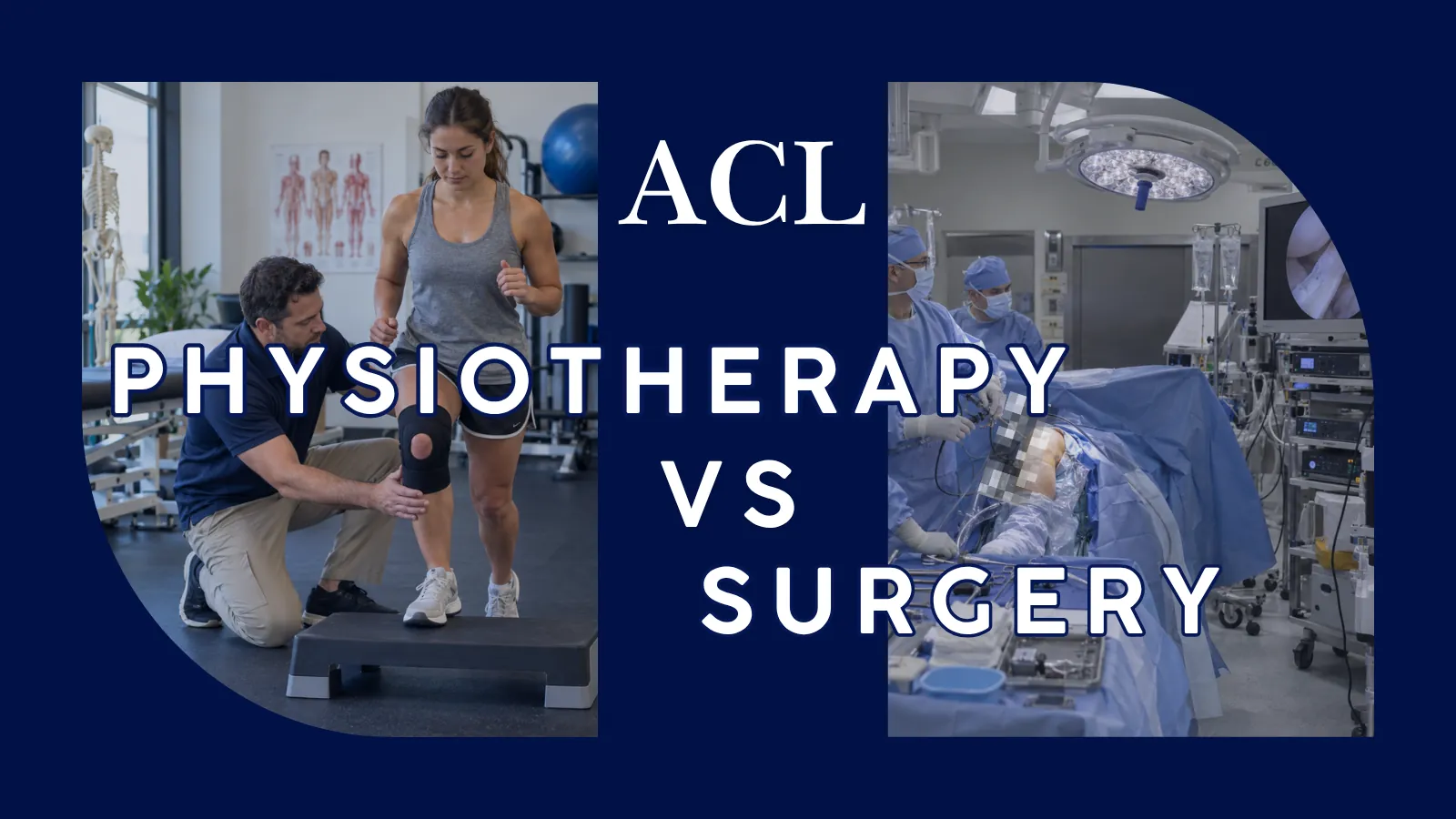
Your MRI says “complete ACL tear.” Does that automatically mean reconstruction? No. The decision depends on how stable your knee is, what else was injured and what you need your knee to do.
- Why an MRI finding does not make the treatment decision alone
- When structured rehabilitation may be appropriate
- When reconstruction deserves serious consideration
Explore this guide
01 THE SHORT ANSWER
An ACL tear is a diagnosis. It is not yet a treatment plan.
Your MRI report says “complete ACL tear.” You may immediately wonder: Do I need surgery? Can physiotherapy help? Will I be able to play sport again?
These are reasonable questions. But an MRI report, however detailed, cannot answer all of them.
Not every ACL tear requires surgery. Equally, not every ACL tear can be managed successfully with physiotherapy alone.
When I assess an ACL injury, I want to understand more than whether the ligament is torn. I need to know how stable the knee is, whether other structures are injured, what movements you need to perform, and what you want to return to.
The right treatment should fit your knee and your goals—not simply the wording of your MRI report.
02 THE MRI IN CONTEXT
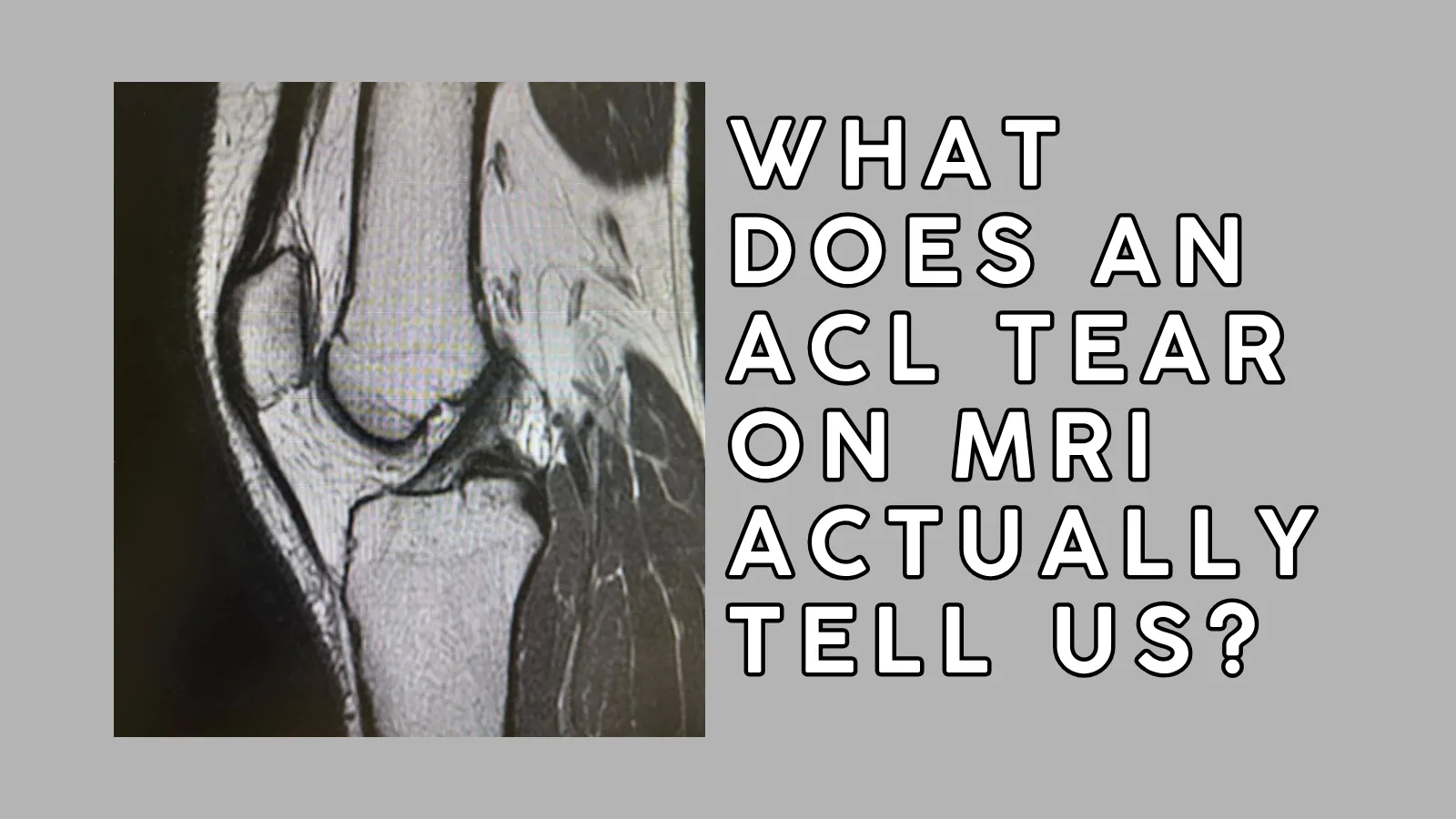
What does an ACL tear on MRI actually tell us?
The anterior cruciate ligament (ACL) helps control forward movement and rotation of the shinbone relative to the thighbone. MRI is useful because it can show whether the ACL is injured and help identify associated meniscus tears, cartilage injuries and bone bruising.
However, MRI is a static examination. It cannot fully demonstrate how your knee behaves when you run, land, turn or suddenly change direction.
For example, one person with a complete ACL tear may walk comfortably, manage everyday activities and develop good functional stability through rehabilitation. Another person with a similar MRI report may experience repeated giving-way episodes, particularly during football, basketball or padel.
The MRI diagnosis may be similar, but the functional problem is different. That is why I combine imaging with your symptoms, clinical examination and activity requirements.
03 THE PATIENT DECISION
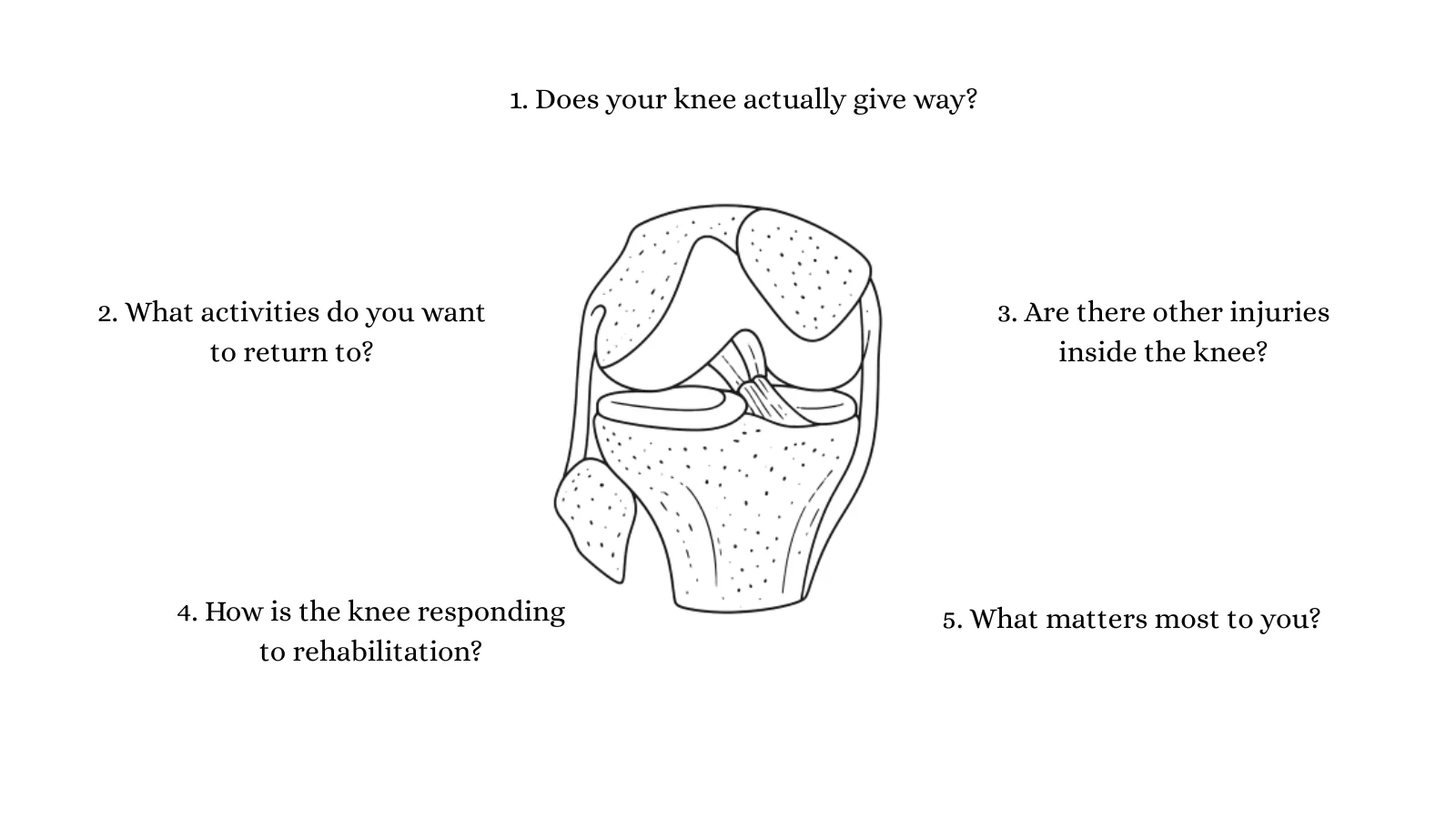
Five questions that guide the treatment decision
Before recommending physiotherapy alone or discussing ACL reconstruction, I consider five important questions.
Does your knee actually give way?
Pain and instability are not the same. An unstable knee may suddenly shift when your foot is planted and you turn. Some patients describe this as the knee slipping or giving way. Others experience weakness or buckling from pain, swelling or poor muscle control.
Clinical tests such as the Lachman and pivot-shift examinations help assess different aspects of ACL-related laxity. Read more about rotational instability after ACL injury.
What activities do you want to return to?
Walking, cycling and controlled gym training place different demands on the ACL than football, skiing, basketball or competitive padel. If your goal is comfortable daily activity, rehabilitation may provide adequate functional stability. If you need frequent pivoting, cutting or unpredictable movements, reconstruction may deserve stronger consideration.
Are there other injuries inside the knee?
ACL tears can occur alongside meniscus tears, cartilage damage and other ligament injuries. A displaced meniscus tear that physically blocks knee movement may require prompt surgical assessment, even when ACL rehabilitation would otherwise be reasonable.
How is the knee responding to rehabilitation?
Improving strength, movement, confidence and stability are encouraging signs. Repeated giving way despite appropriate rehabilitation is different. It suggests the knee may not be reliable enough for the activities you need.
What matters most to you?
Age, medical circumstances, work demands, lifestyle and sporting goals all influence the decision. Age alone does not determine whether reconstruction is appropriate. The aim is adequate function and acceptable risk for your situation.
04 PATHWAY A
When can physiotherapy be enough?
Physiotherapy may be a reasonable primary treatment when the knee is functionally stable and your activity demands can be met safely without reconstruction. Selected patients may include people who:
- Have a partial ACL tear without significant instability.
- Have a complete tear but no recurrent giving way during required activities.
- Do not need to return to frequent pivoting or cutting sports.
- Progress well through an appropriate, structured rehabilitation programme.
- Have no associated injury that independently requires surgery.
It involves swelling control, restored knee extension and flexion, quadriceps and hamstring strength, balance, neuromuscular control, movement confidence and progressive functional loading. Progress needs measurable goals and regular reassessment.7
A brace may be useful for selected patients, but it is not a substitute for rehabilitation or an answer to persistent mechanical instability.
Choosing rehabilitation first also does not mean refusing surgery forever. If instability continues or activity requirements change, the decision can be reconsidered.
05 PATHWAY B
When is ACL reconstruction more appropriate?
ACL reconstruction becomes an important option when the knee cannot provide the stability needed for everyday function, work or sport. Situations that strengthen the case for surgical treatment include:
- Repeated mechanical giving-way episodes.
- Significant instability despite appropriate rehabilitation.
- Plans to return to high-demand pivoting sports.
- Associated meniscus or ligament injuries that change the treatment plan.
- A physically demanding occupation requiring reliable knee stability.
Reconstruction usually uses a tendon graft to restore the ACL's stabilising function. It is not simply stitching every torn ligament back together. The operation has potential risks, including stiffness, infection, graft failure, persistent symptoms and further injury.
Surgery does not replace physiotherapy. Rehabilitation before and after reconstruction remains essential.
When reconstruction is clearly indicated after an acute ACL injury, unnecessary delay should be avoided. The AAOS guideline recommends early reconstruction when surgery is indicated because the risk of additional meniscus and cartilage injury can increase with delay.1 This does not mean every ACL tear needs an immediate operation or that every patient must undergo surgery within a fixed timeframe.
06 A PRACTICAL COMPARISON
Physiotherapy versus ACL reconstruction
The pathways differ, but neither is a shortcut and neither guarantees a return to the previous level of sport.
| Decision point | Rehabilitation-first | ACL reconstruction |
|---|---|---|
| Main approach | Improve functional stability through exercise and movement training. | Restore ligament stability surgically, followed by rehabilitation. |
| Often considered when | Knee function is stable and activity demands are compatible. | Instability persists or functional demands are high. |
| Main limitation | Mechanical instability may remain. | Surgical complications and graft injury remain possible. |
| Recovery | Progress follows strength, symptoms and functional milestones. | Requires graft recovery plus criterion-based rehabilitation. |
| Later decisions | Surgery remains an option when necessary. | Ongoing rehabilitation and safe return-to-sport testing remain essential. |
07 EVIDENCE, NOT PROMISES
What does the research actually say?
Research helps us understand the options, but it must be applied to the right patient.
KANON
In young active adults with recent ACL tears, early reconstruction and rehabilitation with an option for later surgery produced similar average patient-reported knee outcomes at 11 years. Approximately half of the rehabilitation-first group eventually underwent reconstruction.5
COMPARE
Early surgery showed a small advantage in knee-function scores at two years, but the clinical importance of that difference was uncertain. Around half of patients initially allocated to rehabilitation did not undergo reconstruction during the trial.4
ACL SNNAP
For patients with a more longstanding ACL injury and persistent instability, a surgical-management strategy produced better average knee-function outcomes at 18 months than rehabilitation-first treatment. Both groups improved.6
The distinction between recent injury and longstanding symptomatic instability matters. These trials do not support one treatment for everyone.
There is also no reliable basis for promising that ACL reconstruction will completely prevent future knee arthritis. Long-term joint health depends on the original injury, associated damage and subsequent function.
08 SHARED DECISION-MAKING
A practical decision pathway after an ACL tear
Confirm the complete injury pattern
Review the history, clinical examination, MRI, and any associated meniscus, cartilage or ligament injury.
Identify urgent problems
A locked knee, significant associated injury or suspected serious trauma may change the priority.
Assess stability and goals
Does the knee give way? What daily activities, work or sport must it tolerate?
Choose and reassess
Start structured rehabilitation where appropriate, or plan reconstruction when the indications are clear; review progress over time.
09 WHEN TO SEEK HELP
When should you seek urgent assessment?
After a knee injury, seek urgent medical assessment if:
- The knee is truly locked and cannot fully straighten.
- You cannot bear weight following significant trauma.
- There is obvious deformity or severe, rapidly increasing swelling.
- Your foot becomes cold, pale, numb or unusually weak.
- The knee becomes hot and markedly swollen with fever.
Repeated giving way or persistent swelling also deserves timely orthopaedic assessment, even when it is not an emergency. Until the injury has been assessed, avoid testing an unstable knee with aggressive turning, jumping or return-to-play drills.
10 PATIENT QUESTIONS
Frequently asked questions
These answers are general education. They do not replace an individual examination or review of the original MRI images.
Can a complete ACL tear be treated without surgery?
Yes, in selected patients. Some people achieve good functional stability through rehabilitation, particularly when their activity demands are compatible with a non-operative approach. A complete tear still needs assessment and follow-up.
Can I walk normally with a torn ACL?
Yes. Walking in a straight line may be comfortable even when the ACL is completely torn. This does not prove that the knee is stable during pivoting or sport.
Can an ACL heal without surgery?
Some injured ACLs may show restored fibre continuity on later imaging. That does not guarantee normal function or safe return to sport. Treatment decisions should not rely on an assumption that healing will occur.8
If my pain has disappeared, does that mean I do not need surgery?
Not necessarily. Pain often improves before strength and dynamic stability recover. A knee that feels comfortable at rest may still give way during demanding movements.
Will surgery allow me to return to sport faster?
Not automatically. Both pathways require rehabilitation. After reconstruction, progression must account for graft healing, strength recovery and sport-specific readiness. Clearance should use functional criteria rather than a fixed date.7
Should I seek a second opinion before ACL surgery?
A second opinion can be useful when the MRI report, your symptoms and the proposed treatment do not seem to match, or when you are uncertain about rehabilitation versus reconstruction.
11 MY CLINICAL APPROACH
The decision should be about your knee—not just your MRI.
When you receive an ACL tear diagnosis, it is natural to focus on the words “partial” or “complete.” But my priority is to understand whether your knee is stable, whether other structures need treatment, and how we can help you return safely to the activities that matter to you.
Sometimes that means a carefully structured rehabilitation programme. Sometimes reconstruction is the more appropriate option.
The goal is not to operate on an MRI finding. It is to make the right decision for the patient.
If you have an ACL injury, persistent knee instability or questions about an MRI report, you can arrange an assessment with me at Tadawi Specialty Hospital, Al Garhoud, Dubai. Bring your original MRI images, report and previous treatment records so we can discuss your findings, goals and a suitable treatment plan.
12 CLINICAL SOURCES
Evidence and further reading
- AAOS. Management of Anterior Cruciate Ligament Injuries: Clinical Practice Guideline. 2022.
- AAOS OrthoInfo. ACL Injury: Does It Require Surgery? Patient resource.
- Frobell RB et al. Treatment for acute anterior cruciate ligament tear: five-year outcome of a randomised trial. BMJ. 2013.
- Reijman M et al. Early surgical reconstruction versus rehabilitation with elective delayed reconstruction: COMPARE trial. BMJ. 2021.
- Treatment for Acute Anterior Cruciate Ligament Tear in Young Active Adults: 11-Year Follow-up (KANON). NEJM Evidence. 2023.
- Beard DJ et al. Rehabilitation versus surgical reconstruction for non-acute ACL injury: ACL SNNAP. Lancet. 2022.
- Kotsifaki R et al. Aspetar clinical practice guideline on rehabilitation after ACL reconstruction. Br J Sports Med. 2023.
- Association Between ACL Continuity on MRI at 5 Years and 11-Year Outcomes: KANON secondary analysis. 2025.
References are provided for transparency. Study populations differ, and findings cannot replace individual clinical judgment.