





Patient guide · Knee health & sport
Knee Pain When Squatting? A Doctor’s Guide to Safer Squat Form
Squats are not automatically bad for the knees. But sharp pain, swelling, catching, instability or loss of movement should never be dismissed as “normal gym discomfort.” Learn how stance, control, depth and load can be adapted to the knee in front of you.
- Written by
- Dr. Tomislav Cerovecki
- Clinical focus
- Knee & sports injury care
- Clinic
- Tadawi Specialty Hospital, Al Garhoud, Dubai
The essential answer
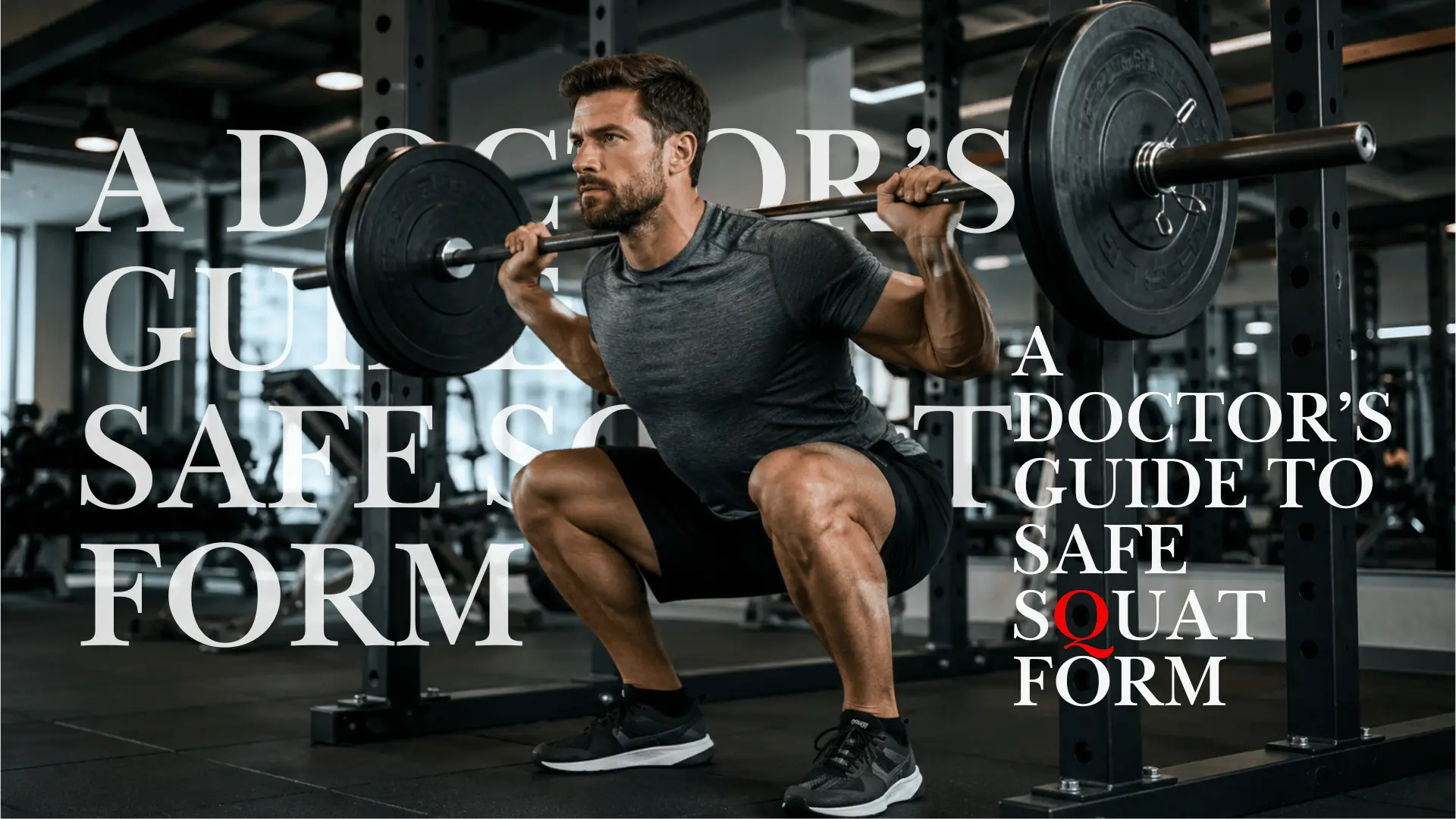
A safer squat is not one rigid position. It is a controlled movement your knee can tolerate.
There is no universal stance width, depth or bar position that suits every person. A useful squat is stable, controlled and progressively loaded. Persistent pain, swelling, locking, instability or loss of movement should lead to assessment—not repeated self-correction under load.
A useful starting point
Squats are not inherently bad for your knees.
Squatting is part of ordinary life: sitting down, standing up, climbing stairs, lifting from a lower level, running, playing sport and training in the gym. A well-planned squat can strengthen the quadriceps, glutes, hamstrings and trunk while improving confidence in everyday movement.
Demand is not automatically damage. Problems often arise when the demand of a movement exceeds what the knee can currently tolerate. That may be a rapid increase in weight, repetitions or weekly training; fatigue-related loss of control; reduced ankle or hip mobility; an incomplete return after injury; or an underlying meniscus, cartilage, tendon, kneecap or ligament problem.
A squat should make the muscles of the legs work. It should not repeatedly create sharp joint pain, increasing swelling, catching, a sense of instability or a feeling that the knee is blocked.
Do not reduce the question to “good” or “bad”: the practical question is whether this squat is appropriate for your current knee, mobility, strength, technique, load and goal.
Technique without myths
Good squat form is not one rigid position.
Bodies differ in hip anatomy, limb length, ankle mobility, experience and training goals. A movement can be controlled without looking identical to somebody else’s.
“Everyone must use the same stance.”
A comfortable stance may be around hip-width to shoulder-width, but it does not need to be identical for every person. A slight toe-out angle can be natural and useful when it supports a stable, comfortable squat.
“Knees must never pass the toes.”
During many normal squatting patterns, especially at deeper ranges, the knees move forward. The more useful questions are whether the feet remain stable, the knees track in a similar direction to the toes, and the load is appropriate.
“Deeper is always better.”
Depth should be earned gradually. The right depth is the deepest range you can reach with control and without provoking meaningful pain, swelling or compensatory movement.
What to aim for
Six practical movement principles
- 1Stable feet: maintain contact through the heel, base of the big toe and base of the little toe.
- 2Controlled descent: bend through the hips and knees together rather than dropping quickly into the lowest position.
- 3Organised trunk: brace enough to avoid collapsing or overextending, without forcing one exaggerated posture.
- 4Knee direction: allow the knees to move in a similar direction to the toes and avoid repeated inward collapse under fatigue.
- 5Appropriate range: use a depth you can control without sharp pain, loss of balance or rising swelling.
- 6Progressive load: add weight, volume or range gradually rather than changing every variable at once.
Watch the movement
How to perform a safer squat: controlled, practical, and knee-aware.
This short video demonstrates a controlled squat pattern. It is not a substitute for individual assessment, particularly after a recent injury or when there is persistent pain, swelling, locking or instability.
- Start with a stable, comfortable stance.
- Let the hips and knees bend together.
- Keep the feet connected to the floor.
- Use only the depth and load you can control.
Short visual guide: use a stable stance, controlled descent and a depth you can manage without sharp pain.
Learn the movement first
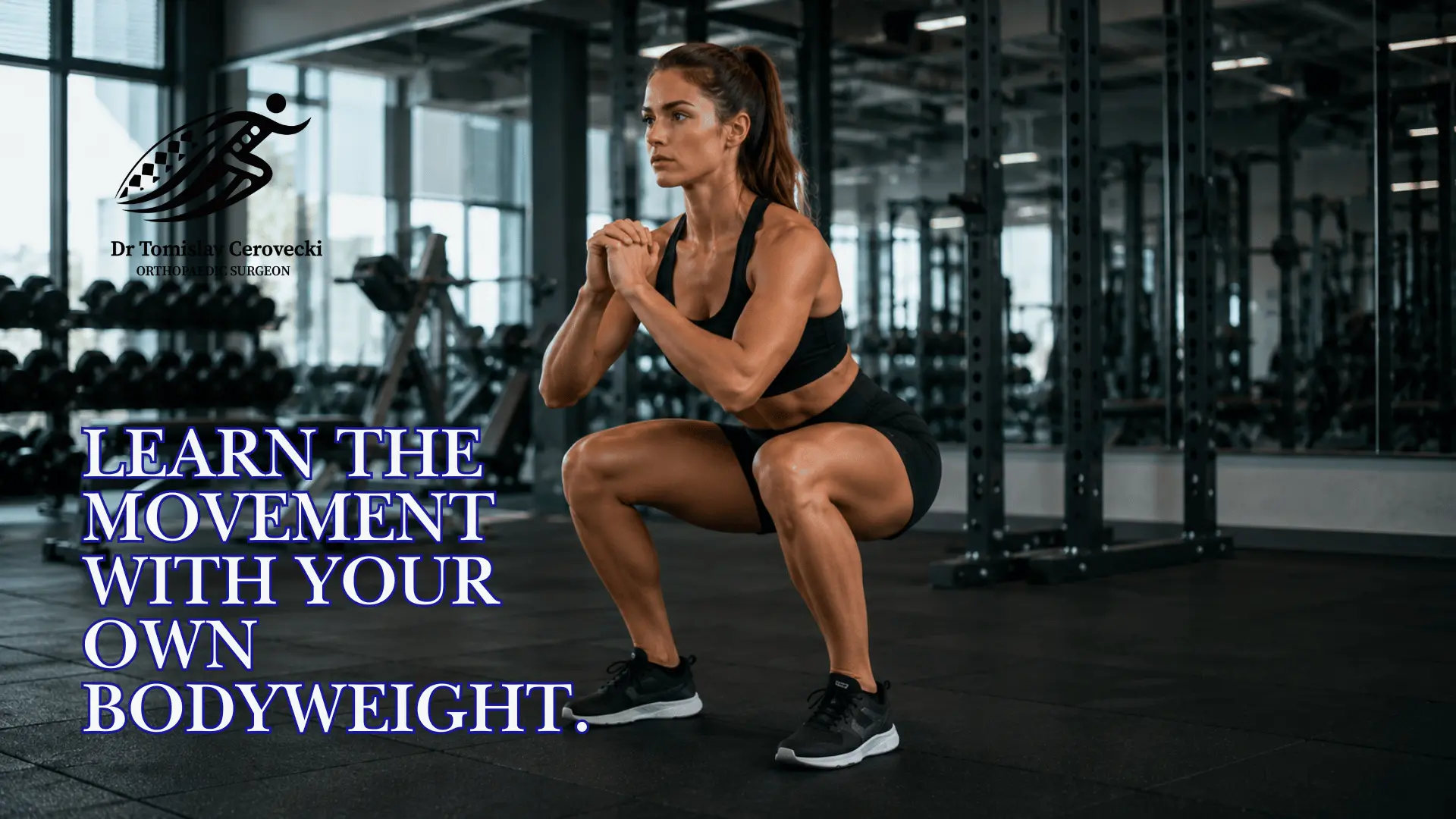
Start with a bodyweight squat before adding load.
Before using a barbell, dumbbells, kettlebell or machine load, learn how the movement feels with your own bodyweight. A bodyweight squat is not “too easy”; it is a practical way to assess balance, depth, confidence and movement control.
Find a stable stance
Stand around hip-width to shoulder-width. Turn the toes out slightly only if it feels natural and helps your hips move comfortably.
Prepare the trunk
Gently brace through the abdomen and trunk. The goal is control, not a forced upright posture or a maximal breath-hold for every repetition.
Move down with control
Lower as if sitting toward a chair: hips move back and down while the knees bend naturally. Do not try to keep the knees completely still.
Stand by pressing through the floor
Keep the foot stable and rise with control. Avoid throwing the chest forward or using momentum to escape the bottom position.
Depth, knees and confidence
How deep should you squat? As deep as you can control—not as deep as social media tells you to go.
The ideal depth changes with mobility, symptoms, injury history, current strength, the weight used and the goal of the exercise.
Chair or box squat
A chair, bench or box provides a consistent target and can make depth easier to control. It is often a sensible early option for pain, lower confidence or return to training.
Controlled bodyweight or goblet squat
As movement improves, a bodyweight or goblet squat can build strength through a larger range without immediately progressing to a barbell.
Loaded squat when ready
Progress load only when the movement is stable and symptoms remain manageable. Quality, recovery and repeatability matter more than a fast increase in weight.
Can your knees go over your toes?
Yes. During many normal squatting patterns, especially as depth increases, the knees move forward. Trying to keep them artificially behind the toes may shift more demand to the hips and trunk. Focus on stable feet, controlled movement, appropriate loading and symptoms—not a single visual rule.
When the knee hurts
Five common reasons knees become painful during squats.
Pain can come from load, movement control, mobility or a specific knee condition. The pattern of symptoms matters more than one generic internet diagnosis.
Load increased too quickly
Adding weight, repetitions, depth, gym sessions, running, football, padel or cycling at the same time can exceed current tolerance. Change one major variable at a time.
Control deteriorates with fatigue
Unstable foot contact, repeated inward knee collapse, excessive twisting or loss of balance can be a sign that the load, depth or repetition target is too demanding today.
Limited ankle or hip mobility
Restricted movement can lead to compensation. A supported squat, small heel elevation, adjusted stance or reduced depth may help while mobility and strength improve.
Front-of-knee pain
Discomfort around the kneecap can relate to overload, patellofemoral pain or patellar tendon symptoms. The answer is usually an individual adjustment of range, load, frequency and rehabilitation—not an automatic ban on every lower-body exercise.
Explore front-of-knee pain careInner-knee pain, catching or locking
Pain along the inner joint line after a twist may raise concern about the medial meniscus or other internal knee structures. A click is not always serious, but recurrent catching, locking, swelling or loss of extension deserves assessment.
Read about inner-knee pain, catching or lockingModify, do not abandon
Smart squat modifications can keep training moving forward.
A modification is not a failure. It is often the most intelligent way to keep building capacity while reducing unnecessary irritation. The best variation is the one that fits the diagnosis, the current ability and the training goal.
Chair or box squat
Controls depth and creates a repeatable target.
Counterbalanced squat
A light weight held in front can help some people feel more balanced.
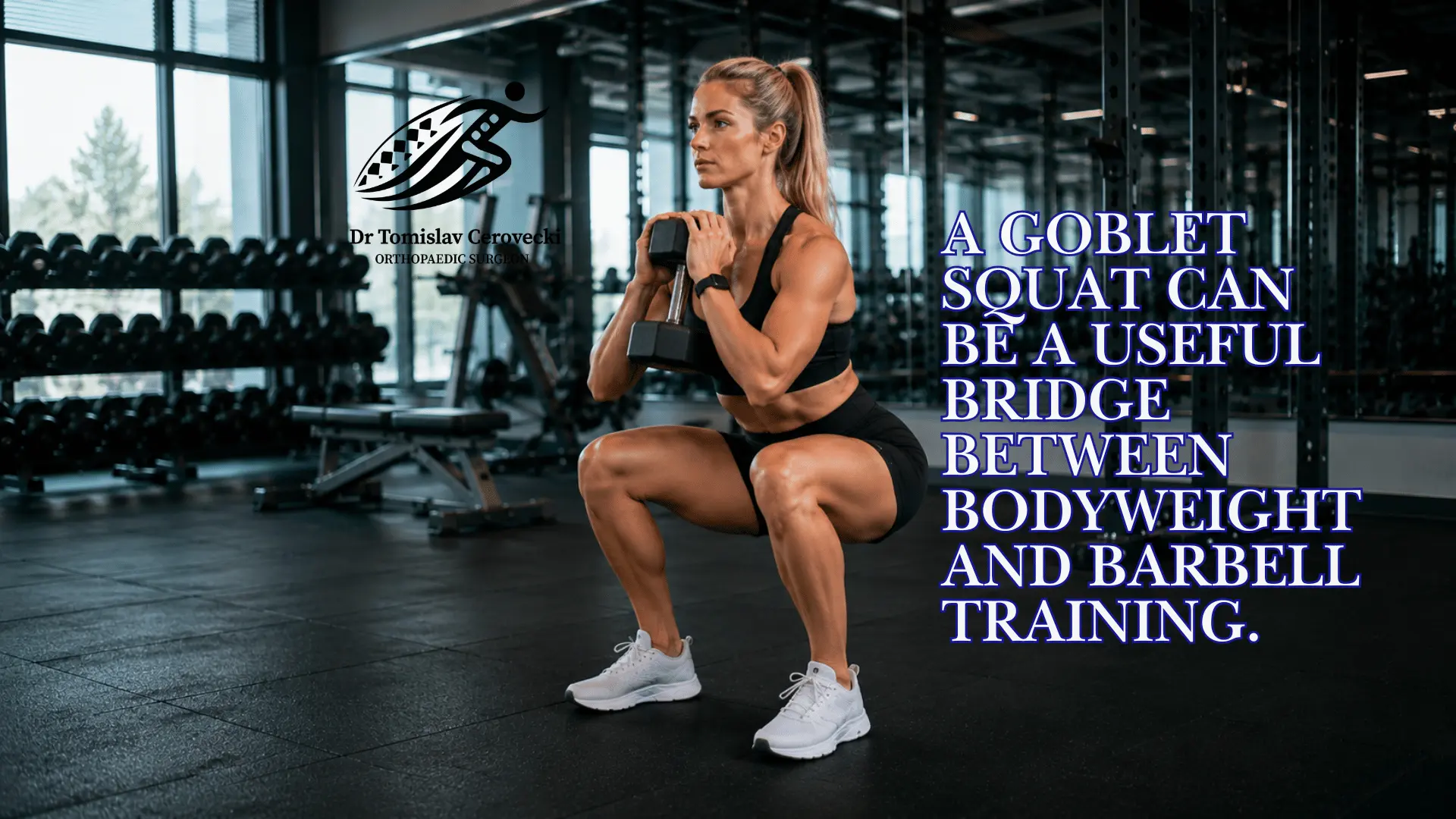
Goblet squat
A practical bridge between bodyweight work and barbell loading.
Reduced range or slower tempo
Helps identify where control or symptoms change and allows graded progression.
Supported squat or split squat
Useful alternatives when one variation is better tolerated than another.
Structured rehab
Appropriate when pain, injury history or performance goals need a tailored plan.
Do not self-manage every symptom
When should you stop squatting and seek medical assessment?
Some exercise-related discomfort can settle with intelligent load adjustment. But a painful knee after a twist, fall, pivot or sports injury may need a clearer diagnosis before training continues.
In selected situations, MRI can be useful to assess a suspected meniscus, ligament, cartilage or other internal knee injury. Imaging supports the diagnosis; it does not replace the physical examination.
Arrange prompt orthopaedic review for:
- A knee that locks or cannot fully straighten
- Significant swelling after a twist, fall, pivot or sports injury
- Repeated giving-way, instability or concern about ligament injury
- Severe pain that does not settle after reducing activity
- Pain that continues to limit daily life despite sensible exercise adjustment
Urgent medical assessment: inability to bear weight after major trauma, deformity, a hot red knee with fever, severe rapidly worsening pain or swelling, new numbness or weakness.
Squats and arthritis
Can people with knee arthritis squat?
Many people with early knee osteoarthritis can still benefit from tailored strengthening. The movement may need to start with a chair squat, smaller range, lighter resistance, slower progression or supervised rehabilitation. The goal is not to prove you can perform the deepest squat; it is to build stronger legs, confidence and useful knee function.
It is sensible to review the plan when pain is sharp, swelling increases, symptoms worsen from session to session, or the knee does not recover in a reasonable way. For individual care, the best programme reflects symptoms, function, other health conditions and goals—not a generic online routine.
Explore knee treatment optionsPatient questions
Safe squat form and knee pain FAQs
These answers are general education. They do not replace an individual assessment after injury or a clinician-guided rehabilitation plan.
Are squats bad for your knees?
No. Squats are not inherently bad for knees. Appropriate squatting can be part of strength and functional training. The key variables are current symptoms, technique, depth, load, recovery, training progression and any underlying knee condition.
Should my knees go over my toes when I squat?
They can. In many normal squat patterns, especially at deeper ranges, the knees move forward over the toes. Focus on stable feet, controlled movement, appropriate loading and symptoms rather than forcing the knees to stay behind the toes.
How deep should I squat if my knees hurt?
Use the deepest range you can control without sharp pain, loss of balance or meaningful swelling afterward. A chair or box squat can be a sensible starting point. Depth can be progressed as strength, mobility and tolerance improve.
Why does the front of my knee hurt during squats?
Front-of-knee pain can relate to patellofemoral pain, tendon symptoms, overload or other causes. It may be influenced by training volume, depth, load, fatigue and movement control. Persistent symptoms should be assessed rather than diagnosed from one exercise alone.
Can squats cause a meniscus tear?
A controlled squat is not automatically expected to cause a meniscus tear. A tear is more commonly associated with a twisting injury, pivot, fall, sport trauma or degenerative tissue change. Inner-joint-line pain with swelling, catching, locking or loss of extension should be assessed.
Can I squat with knee arthritis?
Many people with early knee osteoarthritis can benefit from individually tailored strengthening. The range, load, variation, pace and progression may need adjustment. A structured programme should be reviewed if pain is sharp, swelling increases or symptoms steadily worsen.
When should I stop squatting and see a doctor?
Seek assessment for a locked knee, inability to fully straighten, significant swelling after injury, repeated giving-way, inability to bear weight after trauma, severe persistent pain, fever or redness, numbness, weakness, deformity, or symptoms that continue to limit daily activity despite sensible adjustment.
Clinical reading
Evidence-informed, diagnosis-first advice.
This guide is designed for general education. Advice after injury, surgery or a diagnosed knee condition should be individualised.
- American Academy of Orthopaedic Surgeons: Knee Conditioning Program— controlled strengthening, gradual progression and pain-aware exercise guidance.
- NICE guideline NG226: Osteoarthritis in over 16s— tailored therapeutic exercise and symptom- and function-guided management.